
Richard Barwick project sheet (as a subcontractor to West Kent Housing Association). Coombs and Partners were not directly involved. Please see below.
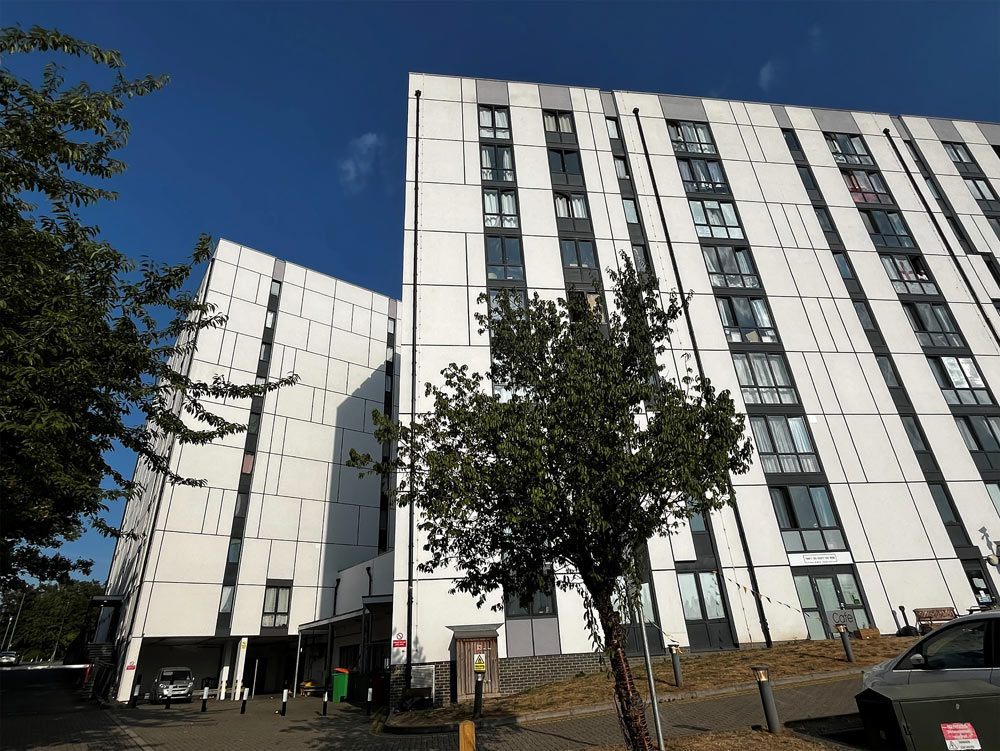
Key parties
West Kent Housing Association
Description
Tennyson Lodge is expressly identified by the landlord as a higher-risk building, although they do not own the building; they are the leaseholder, while the building owner is Kent County Council (KCC). The landlord worked closely with KCC on HRB registration, preparation of the Building Safety Case, annual fire risk assessments, quarterly fire-door inspections, fire-safety equipment and resident communication.
The cladding problem comprised not simply replacement of an ageing façade. The publicly recorded defects involved three fundamental fire-safety elements: defective cladding; combustible insulation; inadequate/required fire breaks. KCC approved progression of the required works and authorised its Director of Infrastructure to enter into the necessary contracts and agreements. The remediation was subsequently completed. West Kent’s 2022/23 annual report states that it had completed replacement of the defective cladding on Tennyson Lodge, working closely with Kent County Council. All parties worked closely together to solve the cladding problem. This is very close to the principle behind the Higher Risk Buildings Working Group that Richard Barwick chairs. HRBs are too technically complicated, financially demanding and interconnected for individual organisations not to work collaboratively.
Year – 2023
Primary risks
- Failure to develop a sufficiently complete and coordinated design for the relevant BSR application can cause substantial programme delay.
- Existing façade fire performance. Removing cladding may reveal that the problem extends beyond the project scope.
- Structural adequacy and fixing risk. A recladding project can become partly a structural remediation project.
- Temporary fire-safety risk. Removing the existing façade temporarily alters the building's fire performance. The sequence of removal and reinstatement is a safety-critical design issue.
- Residents remaining in occupation. Interruptions to services and access into flats all affect residents. Vulnerable residents and repeated access failures.